Vitamin D and K2 Supplements: How to Formulate a Product That Holds Up
Vitamin D and K2 has become one of the most recognizable pairings in the supplement aisle. For consumers, it looks simple: two vitamins, one product. For the brand behind it, it’s one of the more technically demanding formulas to get right. Both nutrients are dosed in micrograms, both are fat-soluble, and vitamin K2 in particular can lose potency quickly when it’s combined with the wrong ingredients.
At NutraStar, we see the same questions come up whenever a brand plans a vitamin D and K2 product: which forms to use, how to keep them stable, and how to label them correctly. This guide walks through each of those decisions from a manufacturing point of view, whether the finished product is capsule, tablet or powder.
Why vitamin D and K2 are paired
The pairing comes down to calcium. According to the NIH Office of Dietary Supplements, vitamin D promotes calcium absorption in the gut. Vitamin K, as described in the NIH vitamin K fact sheet, acts as a coenzyme for proteins involved in blood clotting and bone metabolism. Together, they give brands a clear bone-health story, and they often appear alongside calcium and magnesium in the same formula.
That combination is where the formulation challenges begin. Each added mineral, oil and excipient affects how well the two vitamins hold their potency over time.
Choosing the right vitamin D and K2 forms
Form selection sets the foundation for stability, labeling and cost.
Vitamin D. Most supplements use vitamin D3 (cholecalciferol) rather than D2 (ergocalciferol). The NIH notes that vitamin D3 is typically made from lanolin, which comes from sheep’s wool, and that an animal-free D3 sourced from lichen is also available. For brands targeting plant-based shoppers, lichen-derived D3 makes a vegan claim possible. NutraStar’s Vegan certification supports those products.
Vitamin K2. Vitamin K2 is a family of menaquinones. The two forms used most in supplements are MK-4 and MK-7. MK-7 is the most common choice for once-daily vitamin D and K2 products, and it comes from either fermentation or chemical synthesis.
Not all MK-7 is equal. Raw materials differ in purity, and those differences carry through to the finished product, as the next section shows.
The stability challenge with vitamin K2
Vitamin K2 as MK-7 is the most fragile part of most vitamin D and K2 formulas. A 2019 study in Molecules by Orlando and colleagues looked at why finished MK-7 supplements so often contain less than their labels state. The researchers found that MK-7 is unstable in alkaline conditions and that minerals commonly paired with it, such as calcium and magnesium salts, can speed its breakdown. They also found that MK-7 raw materials with higher purity held up noticeably better in formulation, which could explain the gaps between labeled and actual content seen in products on the market.
Vitamin D3 has sensitivities of its own. It can degrade with exposure to light, heat and oxygen, which is why it’s usually supplied either dissolved in oil or as a stabilized powder.
In practice, brands protect a vitamin D and K2 formula with a few proven strategies:
- Start with a high-purity, well-documented MK-7. The supplier’s purity and stability data matters as much as the price.
- Use stabilized ingredient forms. Microencapsulated MK-7 and D3 beadlets put a protective barrier between the vitamin and the rest of the blend.
- Be careful with alkaline minerals. If the formula includes calcium or magnesium, choose the salt form and excipients with K2 stability in mind.
- Size overages from data. Overages should be based on stability results, not rules of thumb.
At NutraStar, our R&D team reviews these interactions before a formula goes to production, so stability problems are caught on the bench rather than on the shelf.
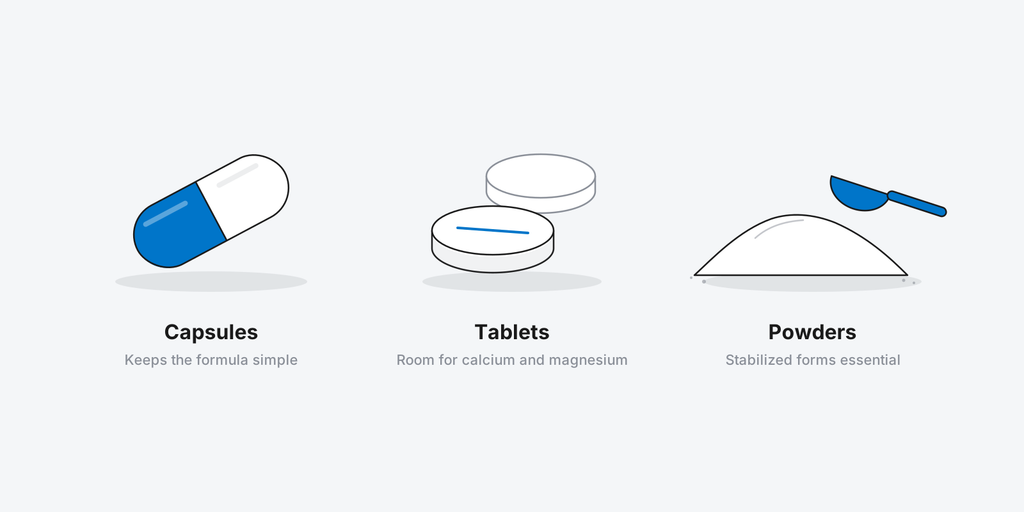
Choosing a dosage form
Each dosage form handles vitamin D and K2 differently:
- Capsules. Hard capsules work well with powdered, stabilized forms of D3 and MK-7, and they keep the formula simple.
- Tablets. Tablets are common when vitamin D and K2 are combined with calcium or magnesium in a bone-health formula. They allow higher mineral doses, but they also carry the greatest risk of mineral-driven K2 loss.
- Powders. Vitamin D and K2 can be added to drink mixes, though water and oxygen exposure make stabilized forms essential.
Whatever the form, the dose is tiny. A 100 mcg dose of vitamin D3 inside a 500 mg tablet makes up just 0.02% of the fill. Getting that amount into every unit takes careful premixing and blending, followed by content uniformity testing. NutraStar manufactures capsules, tablets and powders, so the dosage form can be chosen for the formula rather than for what a facility happens to run.
Labeling vitamin D and K2 correctly
Vitamin D and K2 labels have a few details that trip up new brands:
- Units and Daily Values. FDA’s current Daily Values are 20 mcg for vitamin D and 120 mcg for vitamin K. Vitamin D is declared in micrograms, and many brands add the IU amount in parentheses because shoppers still recognize it.
- Name the form. Listing “vitamin D3 (as cholecalciferol)” and “vitamin K2 (as menaquinone-7)” tells buyers exactly what they’re getting.
- Hit 100% of the claim. Under 21 CFR 101.36, added vitamins must be present at no less than 100% of the declared amount. Because a product can be tested at any time before it expires, the MK-7 stability work above is what keeps a vitamin D and K2 label compliant.
- Anticoagulant caution. The NIH advises that people taking warfarin keep their vitamin K intake consistent. Many brands add a statement advising consumers on blood thinners to consult a healthcare provider before use.
- Claims and disclaimers. Bone-health language is a structure/function claim, so it needs the DSHEA disclaimer described in FDA’s claims guidance.
At NutraStar, label compliance review happens before labels go to print, at our FDA-registered and NSF GMP-certified facilities.
Testing a vitamin D and K2 product
Because the doses are so small and K2 is so sensitive, testing carries more weight here than in most vitamin products. A strong testing program covers:
- Identity and purity of incoming D3 and MK-7, including the supplier’s documentation on MK-7 purity
- Assay of both vitamins in the finished product, typically by HPLC
- Content uniformity, to confirm that every unit carries its microgram dose
- Real-time stability testing in the final package, to support the expiration date
Our ISO 17025-accredited in-house lab tests every batch against its specifications. You can read more about our testing services and how we approach third-party supplement testing.
Packaging for vitamin D and K2
Light and oxygen are the main packaging threats to vitamin D and K2. Opaque or amber bottles, induction seals and well-fitted closures limit both, and blister packs offer even tighter protection for each dose. For a closer look at bottle, seal and material choices, see our supplement packaging guide.
Common vitamin D and K2 formulation mistakes
- Choosing MK-7 on price alone. Low-purity raw material is one of the most common reasons finished products miss their K2 claim.
- Adding calcium without a stability plan. Alkaline mineral salts can break down MK-7 unless ingredient forms are chosen carefully.
- Underestimating blend uniformity. Microgram doses need premixes and testing to land evenly in every unit.
- Skipping real-time stability data. Accelerated testing is useful early on, but real-time data in the final package supports the shelf life.
- Leaving out the IU or the form. Clear labels that list micrograms, IU and the specific form build trust with buyers.
Planning your vitamin D and K2 product
A vitamin D and K2 supplement succeeds when ingredient selection, formulation, testing and packaging are planned together. That’s how we work at NutraStar, across more than 250,000 sq ft of facilities in New Jersey and Arizona.
If you’re developing a vitamin D and K2 product or reformulating an existing one, our team is happy to walk you through ingredient forms, dosage formats and timelines. Request a quote or contact our team to start the conversation.


