Vitamin Packaging: How to Protect Potency From Fill to Final Dose
Vitamins are among the most familiar products in the supplement aisle, and among the most fragile. Vitamin C and several B vitamins pull moisture from the air. Fat-soluble vitamins such as A and E break down with light and oxygen. Iron-containing formulas carry federal labeling and packaging rules of their own. For brand owners, vitamin packaging is often the difference between a label claim that holds through expiration and one that fails a potency test.
At NutraStar, packaging is planned alongside the formula, not after it. From our NSF GMP-certified facilities in Farmingdale, New Jersey and Chandler, Arizona, we manufacture vitamin capsules, tablets and powders and package them to protect what’s inside. This guide covers how vitamin packaging affects potency, compliance and cost. For formats and sustainability across all supplement types, see our broader supplement packaging guide.
Why vitamin packaging deserves early attention
Packaging is growing with the category. Grand View Research projects the global nutraceutical packaging market will reach USD 6.95 billion by 2030, growing 5.6% a year from 2025, with vitamins among the segments driving demand.
For vitamins, the stakes are specific. Under the Supplement Facts labeling rules in 21 CFR 101.36, added vitamins and minerals must be present at no less than 100% of the declared amount. Because a product can be sampled at any point before its expiration date, that 100% has to hold for the full shelf life, not just on the day the bottle is filled. Overages help, but they can’t make up for a package that lets moisture and oxygen in.
That’s why packaging belongs in the formulation conversation. At NutraStar, nutrient profile, dosage form and target shelf life are weighed together before a container is chosen.
Know which vitamins are most at risk
Not every nutrient fails the same way, so vitamin packaging should be matched to the most sensitive ingredients in the formula:
- Moisture. Research from Purdue University found that humidity can cause vitamin C and some B vitamins to dissolve and degrade, and the lost potency does not return once the product dries out.
- Light. Fat-soluble vitamins such as A and E are vulnerable to light exposure, which makes opaque or amber containers the safer choice.
- Oxygen. Vitamin C and fat-soluble vitamins oxidize over time, and every opening of a multi-serve container lets in fresh air.
Multivitamins and prenatals combine nearly all of these sensitivities in a single tablet or capsule, which is why they often need the most protective packaging on the shelf.
Matching vitamin packaging to the dosage form
The right vitamin packaging starts with how the product is taken:
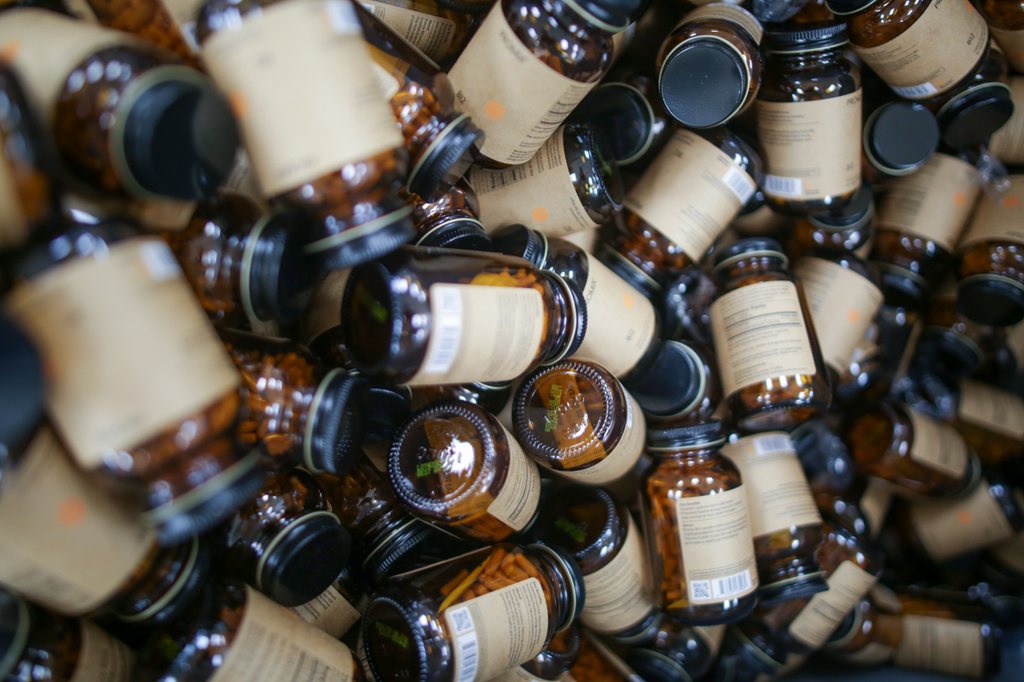
- Tablets and capsules. HDPE bottles are the workhorse for vitamin tablets and capsules. They are durable, lightweight and a strong moisture barrier. Amber or opaque options add light protection for formulas with vitamins A and E.
- Softgels. Softgels can soften or stick together in heat and humidity, so a well-sealed bottle stored away from heat is essential.
- Powders. Vitamin powders, such as vitamin C or B-complex drink mixes, go into jars, tubs or gusseted pouches. Because these containers are opened every day, tight closures and high-barrier materials matter most here.
Bottle sizing matters as much as material. Too much headspace traps more air and moisture with the product. Too little leaves no room for a desiccant. Count size also drives cost per serving, determines how much label space you have for a compliant Supplement Facts panel and, for iron-containing formulas, can decide whether child-resistant packaging is required.
Personalized vitamin lines add another layer of packaging decisions, from pack formats to fulfillment. We cover those in Personalized Vitamins, Customized at Scale.
Seals, desiccants and closures
Three small components do most of the protective work in a vitamin bottle:
- Induction seals. A foil seal bonded to the bottle’s rim provides tamper evidence and blocks moisture and oxygen until the first opening.
- Desiccants. Canisters or packets absorb moisture that enters during filling and every time the bottle is opened afterward. They are especially valuable for formulas heavy in vitamin C and B vitamins.
- Closures. Continuous-thread caps suit most adult products. Child-resistant closures are required for some iron-containing formulas and are a sensible choice for products that appeal to children.
These components cost very little per unit compared with the value of the formula they protect, which makes them one of the most cost-effective decisions in vitamin packaging.
Iron, child safety and vitamin labeling rules
Multivitamins, prenatals and iron supplements carry extra obligations that affect both the package and the label:
- Child-resistant packaging. Under 16 CFR 1700.14, dietary supplements containing 250 mg or more of elemental iron per package must use child-resistant packaging. The threshold is per package, not per dose. A prenatal with 30 mg of iron per tablet crosses it in a 90-count bottle (2,700 mg), so count size directly affects your closure.
- Iron warning statement. Tablets and capsules containing iron as an iron source must carry a specific accidental-overdose warning under 21 CFR 101.17(e), with rules on where it appears.
- Core label elements. Every vitamin label needs a statement of identity, net quantity, Supplement Facts panel, ingredient list, and manufacturer or distributor information.
Smaller containers leave less room for all of this, so label requirements should be checked before a bottle size is locked in.
At NutraStar, label compliance review happens before labels go to print, and packaging and labeling run under 21 CFR Part 111 controls at our NSF GMP-certified facilities.
Testing that proves your vitamin packaging works
Packaging performance should be measured, not assumed. USP General Chapter 671 provides methods for testing moisture permeation and light transmission in containers. Stability testing in the final package then confirms that vitamin content holds under real storage conditions through the labeled shelf life.
Our ISO 17025-accredited in-house lab tests every batch against its specifications. You can read more about our testing services and how we approach third-party supplement testing.
Common vitamin packaging mistakes to avoid
- Choosing the bottle before the formula is final. A container picked for shelf appeal can fail a stability study once the final nutrient profile is set.
- Oversizing the bottle. Extra headspace looks generous on the shelf but leaves more air and moisture in contact with the product.
- Skipping the desiccant. For vitamin C and B-vitamin blends, a desiccant is one of the cheapest forms of protection available.
- Forgetting the iron math. Adding a larger count size to an iron-containing line can push the package past the 250 mg child-resistant threshold.
- Relying on accelerated data alone. Accelerated stability testing helps with early decisions, but real-time data in the final package is what supports the expiration date.
Planning your vitamin packaging
Vitamin packaging is easiest to get right when formulation, testing and packaging happen in one place. That’s how we work at NutraStar, across more than 250,000 sq ft of facilities in New Jersey and Arizona.
If you’re planning a new vitamin line or rethinking packaging for an existing one, our team is happy to walk you through formats, components and timelines. Request a quote or contact our team to start the conversation.


